
Blog
August 4, 2026
Finding Solar Repowering Customers




TLDR
- Your strongest repowering leads may already be in your CRM, service records, and local market.
- Permit data, direct outreach, digital marketing, and referral partners can help identify aging systems before they fail.
- Solar Health Checks create a customer-friendly entry point for assessing needs and uncovering upgrade opportunities.
- A repeatable demand-generation system creates a steadier pipeline than relying on service calls alone.
- Tigo’s flexible solutions help installers serve more existing systems and support future upgrades.
Build a Repeatable Demand-Generation Strategy
Many installers assume that growing a repowering business requires finding entirely new customers. Some part of RePowering will be new customers but know that the strongest opportunities at the start may already be within reach.
Past customers, service requests, aging installations, permit records, local neighborhoods, and professional referral partners can all provide qualified repowering leads. Unlike a brand-new solar sale, these homeowners already own solar and understand its value. They need a trusted professional who can evaluate the system, restore performance, and help them prepare for what comes next.
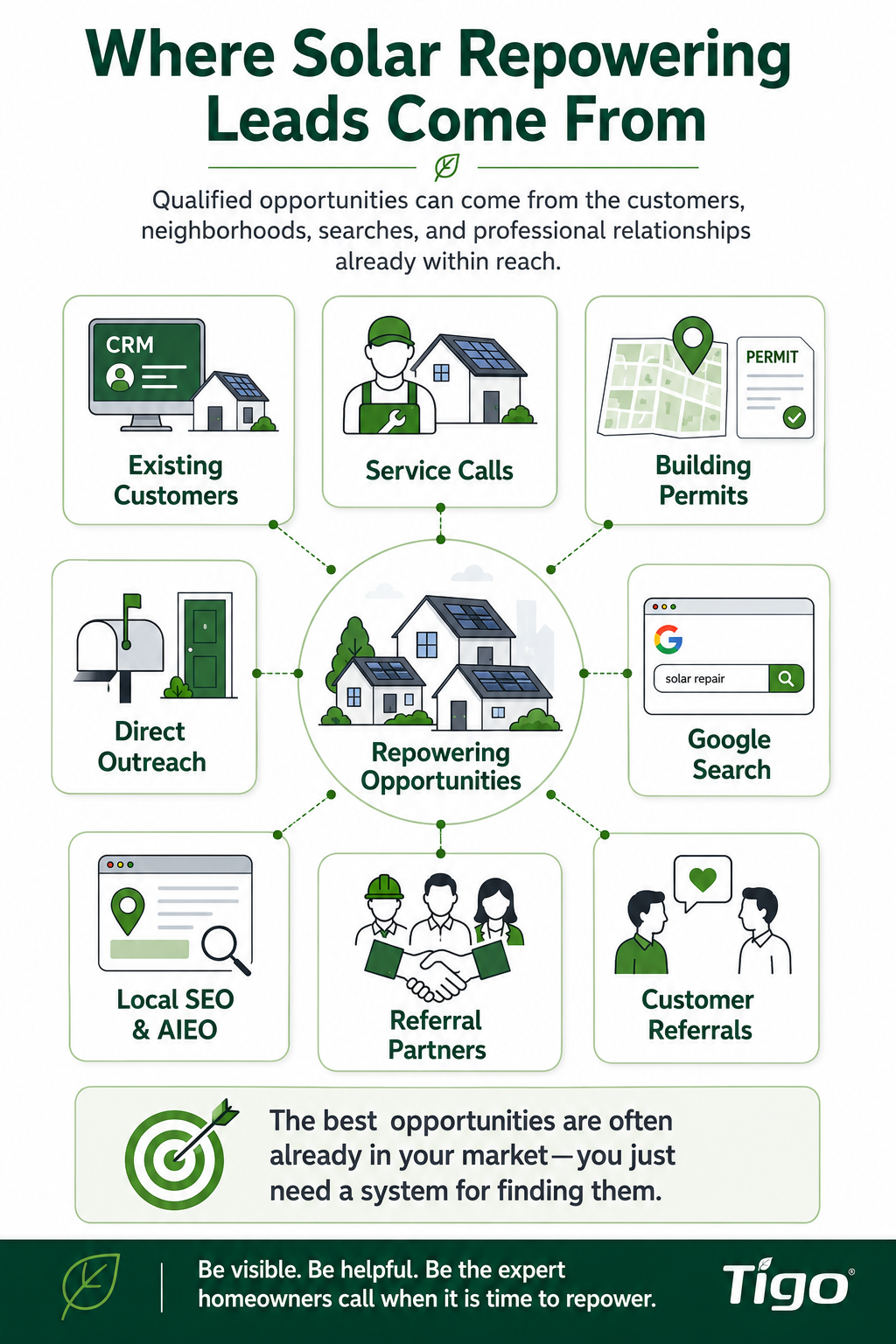
A strong repowering pipeline should combine four lead-generation channels:
- Existing customers
- Local market targeting
- Digital and inbound marketing
- Strategic partnerships
Together, these channels create a more predictable flow of opportunities than relying on service calls alone.
1. Start With Existing Customers
If you have been installing solar for years, your customer database may be your lowest-cost and highest-converting source of repowering leads.
Start by identifying homeowners who:
- Installed solar approximately 10 or more years ago
- Have aging or unsupported inverter technology
- Have never upgraded their monitoring
- Recently contacted you for service
- Have experienced production or communication issues
- Added an EV or increased household electricity use
- Have asked about battery storage or backup power
- Own systems that no longer meet their current energy needs
These homeowners already know your company, which makes them easier to re-engage than a completely new prospect.
Outreach may include:
- Email campaigns
- Seasonal system reminders
- Call campaigns with prepared scripts
- Service follow-ups
- Monitoring alerts
- Invitations to schedule a system assessment
- Battery or inverter upgrade announcements
The goal is not to immediately sell equipment. It is to reopen the relationship and offer a reason to evaluate how the system is performing today.
Use System-Check Language
Homeowners may not understand the term repowering and contacting them with an immediate upgrade offer can feel overly promotional.
A simpler entry point is to use system-check or Solar Health Check language.
For example:
Your solar system has been operating for more than 10 years. A Solar Health Check can help identify potential production issues, aging equipment, monitoring limitations, and potential upgrade opportunities before they become larger problems.
Other customer-friendly language may include:
- Solar system performance check
- Solar health assessment
- System reliability review
- Monitoring and production check
- Solar equipment lifecycle review
- Battery-readiness assessment
This language positions the installer as a service partner rather than a salesperson.
It also creates a natural transition into a broader conversation about monitoring, inverter replacement, optimization, battery storage, or system expansion when those needs are identified.
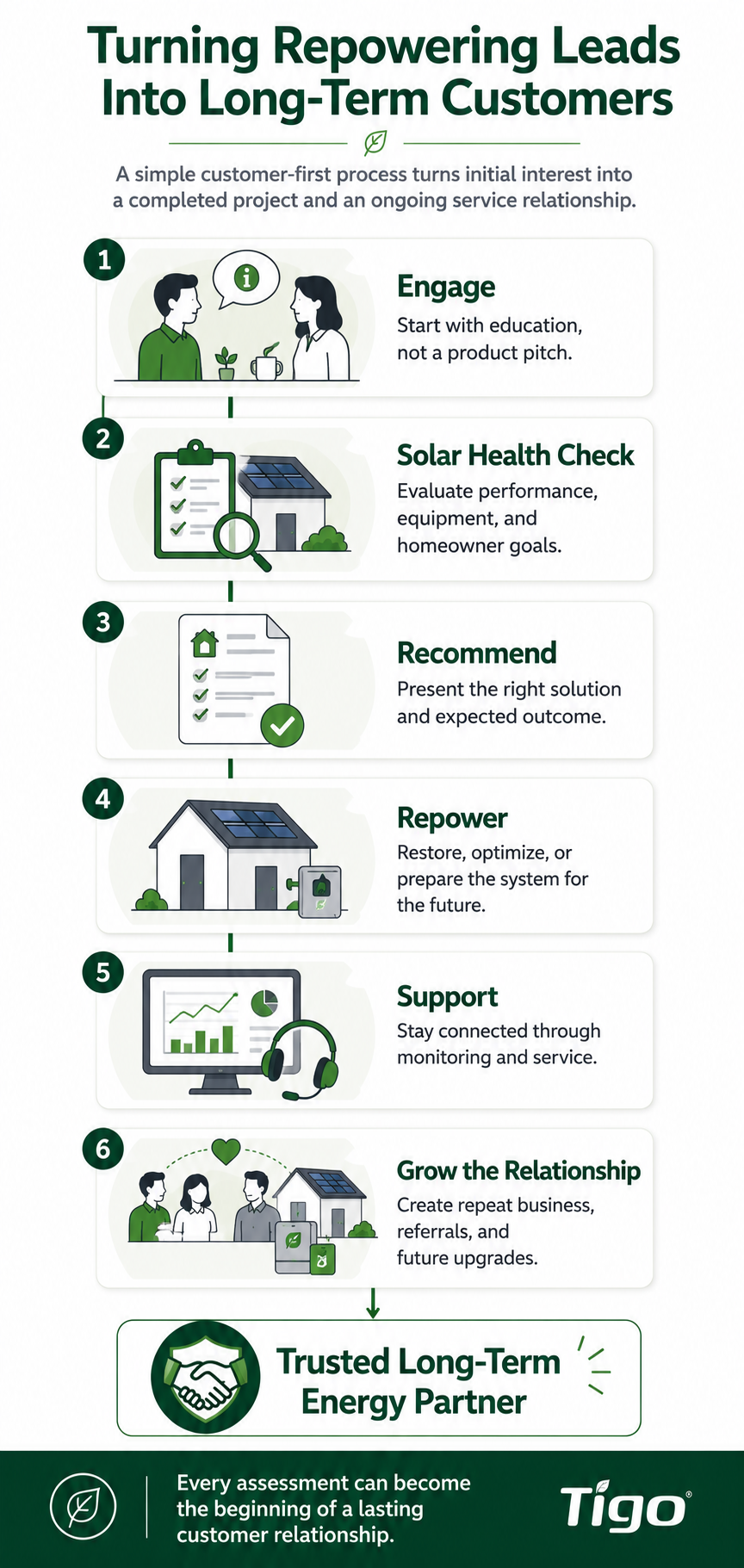
Create a Solar Health Check Program
Rather than treating assessments as occasional promotions, installers can establish a repeatable Solar Health Check program.
A basic program may include:
- Review of system age and available documentation
- Visual equipment inspection
- Production and monitoring review
- Identification of failed, aging, or unsupported components
- Evaluation of homeowner energy needs
- Battery and backup-power readiness
- Discussion of future expansion opportunities
- Written findings and recommended next steps
The assessment can be complimentary, offered as a limited promotion, or provided as a paid professional service depending on the scope and the installer’s business model.
Each assessment should help answer three questions:
- Is the system performing as expected?
- Does any equipment require immediate attention?
- What upgrades could improve the homeowner’s experience now or in the future?
Every assessment creates an opportunity to uncover legitimate monitoring, inverter, optimization, storage, service, or expansion needs.
2. Target the Local Installed Base
Your next repowering customer may not be in your CRM. They may live in a nearby neighborhood with a solar system installed by another company—possibly one that no longer services the system.
Local market research can help installers identify these opportunities more intentionally.
Use Building-Permit Data to Identify Aging Systems
Local building departments often maintain permit records for residential solar installations. Depending on the jurisdiction, these records may be available through:
- Online municipal permit portals
- Public-record databases
- Building-department requests
- County or city planning offices
- Third-party property and permit-data services
Permit records can help installers identify:
- When a solar system was installed
- Which neighborhoods have a concentration of older systems
- The original installer or contractor
- Approximate system size
- Properties approaching common inverter or equipment-replacement windows
This information can be used to build a focused outreach list instead of marketing broadly to every homeowner in a service territory. (Installers should follow all applicable public-record, solicitation, privacy, and marketing requirements when collecting and using permit information.)
Use Direct Mail to Reach Older Solar Homes
Once target neighborhoods or properties have been identified, direct mail can introduce the installer’s repowering and system-assessment services.
The message should focus on homeowner value rather than equipment.
For example:
Has your solar system been operating for 10 years or more? A Solar Health Check can help identify production issues, aging equipment, monitoring limitations, and opportunities to prepare for battery storage or future energy needs.
A direct-mail campaign may promote:
- Solar Health Checks
- Inverter replacement
- Monitoring restoration
- Battery-readiness reviews
- Solar repair and modernization
- Service for systems installed by companies no longer in business
Keep the message simple and include one clear action, such as scheduling an assessment or requesting a consultation.
Consider Targeted Door-to-Door Outreach
Door knocking can also support a local repowering campaign, particularly in neighborhoods with a high concentration of older solar systems.
The approach should be educational and targeted—not a generic solar sales pitch.
A simple introduction might be:
“We are helping homeowners in this area evaluate older solar systems for production, monitoring, and equipment issues. We are offering Solar Health Checks for systems that have been operating for approximately 10 years or more. Would you be interested?"
Representatives should be prepared to explain:
- Why the neighborhood was selected
- What the system check includes
- That the homeowner is not being asked to replace the entire system
- How an assessment can identify immediate and future needs
Door-to-door outreach is most effective when combined with mailed materials, neighborhood-specific landing pages, or follow-up email campaigns. (Installers should also comply with local solicitation and licensing requirements.)
3. Strengthen Digital and Inbound Marketing
When homeowners experience production problems or equipment failures, many begin with an online search. Your website should answer the questions they are already asking.
Create dedicated pages and educational content around topics such as:
- Solar inverter replacement
- Solar system repair
- Solar system upgrades
- Battery retrofit
- Aging solar systems
- Solar monitoring upgrades
- Solar repowering
- Repair versus replacement
- Home battery installation
- Solar company out of business
- Solar system not producing
- Solar Health Check
Educational content builds trust before the first conversation takes place and helps position your company as the local expert for existing solar systems.
Use SEO, AIEO, and Paid Search
Local search visibility is especially important because repowering customers often need help quickly.
Optimize your website and Google Business Profile for location-based searches such as:
- Solar repair near me
- Solar inverter replacement
- Solar system not working
- Solar monitoring repair
- Solar battery retrofit
- Solar repowering company
- Solar service for orphaned systems
SEO and AI engine optimization can help your educational content appear in traditional search results and AI-powered search experiences.
Paid search campaigns can also target high-intent phrases such as:
- “Solar not working”
- “Replace solar inverter”
- “Solar company went out of business”
- “Add battery to existing solar”
- “Upgrade old solar system”
The strongest campaigns lead homeowners to a dedicated service page with a clear Solar Health Check or assessment call to action.
Stay Visible Before the System Fails
The most successful repowering businesses do not wait for the phone to ring. Ongoing demand-generation activities may include:
- Educational email campaigns
- Customer newsletters
- Google Business Profile updates
- Local SEO and AIEO
- Paid search campaigns
- Social media content
- Community workshops
- Utility-bill review campaigns
- Direct-mail campaigns
- Neighborhood outreach
- Annual Solar Health Check promotions
The goal is to become visible before the homeowner experiences a complete system failure.
4. Build Strategic Referral Partnerships
Many homeowners needing repowering will not begin by calling a solar installer. They may first contact:
- Roofing contractors
- Electricians
- Real estate agents
- Home inspectors
- Property managers
- General contractors
- Insurance restoration companies
- HVAC contractors
These professionals frequently encounter older solar systems during roofing projects, electrical upgrades, home sales, inspections, storm repairs, and electrification projects.
Building relationships with them can create a steady source of qualified referrals.
Make the Partnership Easy to Use
A strong referral partnership should include more than an informal agreement to exchange names.
Create a simple, repeatable process that may include:
- Meeting with local companies to explain repowering services
- Training partners to recognize potential repowering needs
- Establishing a referral agreement
- Providing a dedicated referral contact
- Developing co-branded homeowner materials
- Offering a Solar Health Check for referred customers
- Creating a simple online referral form
- Following up with the partner after the customer is served
For example, a roofer preparing to replace a roof may uncover an aging inverter, damaged wiring, outdated monitoring, or a homeowner interested in battery storage.
An electrician installing an EV charger may identify increased energy needs that justify additional solar capacity or storage.
The easier it is for partners to identify and refer these opportunities, the more consistently the channel will produce leads.
Turn Customers Into Referral Sources
Satisfied repowering customers can also become strong advocates. After completing a project:
- Ask for a review
- Request introductions to neighbors with older solar systems
- Offer a formal referral program
- Share before-and-after production results
- Provide educational materials the homeowner can pass along
- Follow up about future monitoring, battery, or service needs
Neighborhood referrals can be especially effective because nearby homes may have systems installed at approximately the same time and may be facing similar equipment or service issues.
Don't Wait for the Phone to Ring
The most successful repowering businesses actively create demand. That may include:
- Educational email campaigns
- Customer newsletters
- Google Business Profile optimization
- Local SEO
- Paid search campaigns
- Social media content
- Community workshops
- Utility bill review campaigns
- Annual system health check promotions
The goal is to stay visible before the homeowner experiences a system failure.
Why Tigo Helps You Reach More Customers
One of the biggest challenges in repowering is that every existing solar system is different. Different inverter brands. Different module types. Different ages. Different homeowner goals. Rather than requiring a complete system replacement, Tigo gives installers the flexibility to modernize many existing systems through targeted upgrades.
Whether the project involves restoring production, adding monitoring, improving performance, replacing an inverter, or preparing for battery storage, Tigo enables installers to recommend solutions that fit the homeowner's needs—not just a single product line.
That flexibility expands the number of projects installers can pursue and helps convert more inquiries into completed repowering projects.
Chapter Takeaway
Finding solar repowering customers isn't about waiting for equipment to fail—it's about building a repeatable lead-generation strategy.
By combining existing customer outreach, service work, local partnerships, digital marketing, and educational content, installers can create a steady pipeline of repowering opportunities.
With flexible solutions that support a wide range of existing solar systems, Tigo helps installers serve more homeowners, close more projects, and build lasting customer relationships.
Continue Reading
Once you've built a consistent pipeline of repowering opportunities, the next step is turning those opportunities into a repeatable business.
Next Chapter 6 → Launching Your Repowering Business in 90 Days
--
Below is a full list of chapters included in this series:
- Summary: The Solar Repowering Opportunity
- Why Repowering Has Become a Major Growth Market
- Building a Profitable Solar Repowering Business
- How to Package and Sell Solar Repowering Services
- Finding Solar Repowering Customers
- Launching Your Repowering Business in 90 Days
- Building a Sustainable Solar Repowering Business
- Resources and Glossary of Repowering Terms
