
Blog
September 2, 2026
Can You Add Battery Storage to an Existing Solar System?



Estimated read time: 6–7 minutes
TL;DR
- Yes, battery storage can often be added to an existing solar system, but the right approach depends on the inverter, electrical design, available equipment, local requirements, and what you want the battery to do.
- If your inverter already needs replacement, this may be a good time to consider a storage-ready hybrid inverter rather than replacing it with a basic solar-only option.
- You do not have to add the maximum amount of storage on day one. Some systems are designed so storage capacity can be sized for current needs and expanded later within product and design limits.
- Backup power, using more of your solar after sunset, and managing energy around utility rates are different goals. Tell the installer which problem you are trying to solve.
- The best starting point is a professional assessment of the solar system you already own.
You already have solar. Can you add a battery later?
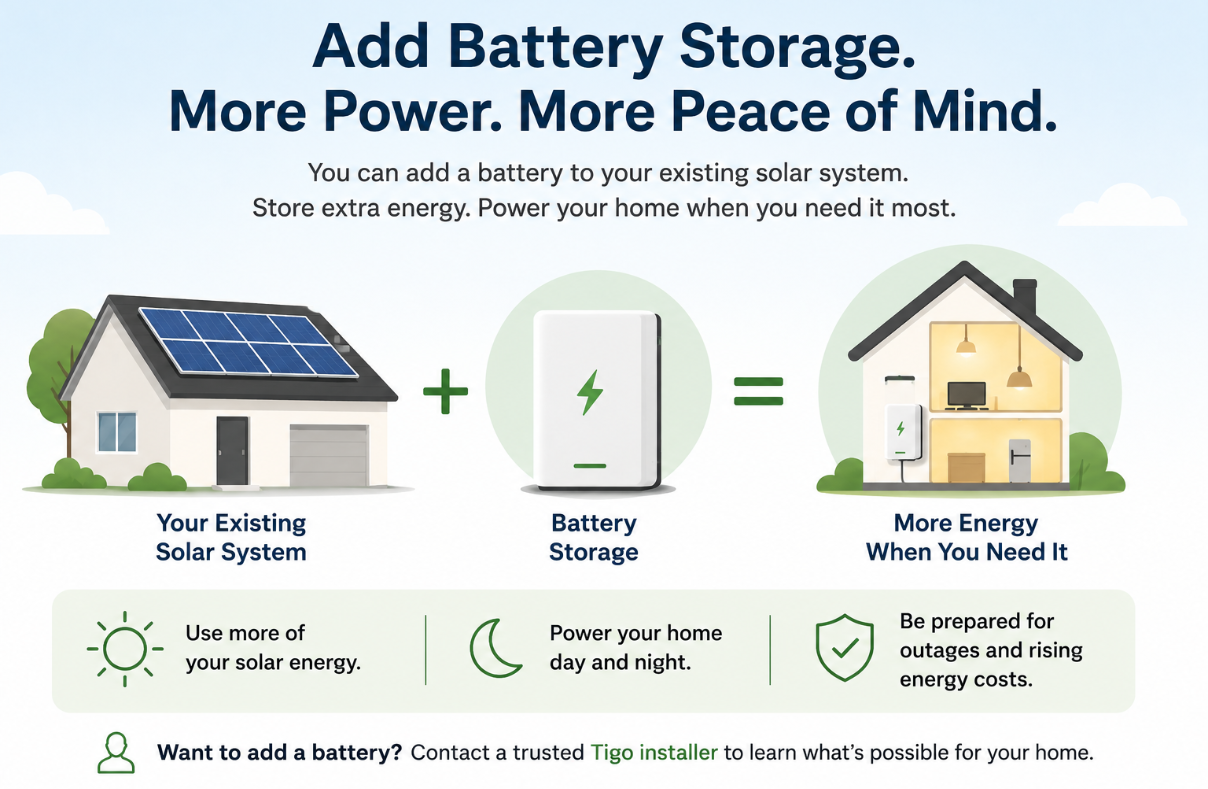
In many cases, yes. Adding battery storage to an existing solar system is commonly called a storage retrofit. The important part is that “can I add a battery?” is not just a yes-or-no question. The installer needs to understand the system you already have and what you want the battery to accomplish.
EnergySage notes that many existing solar systems can accommodate a battery retrofit, but the ease of the project depends heavily on the inverter and current system setup.
Helpful resource: EnergySage guide to adding a battery to an existing solar system
That is why storage belongs at the end of the homeowner repowering journey, not the beginning. First understand how the solar system is performing. Maintain it. Diagnose problems. Then decide whether you are simply restoring the existing system or using the project as an opportunity to expand what your home energy system can do.
Start with the goal, not the battery
Homeowners add storage for different reasons. Before choosing equipment or capacity, tell the installer what you actually want.
- Backup power during grid outages
- Using more of your solar energy after the sun goes down
- Managing energy around time-of-use or other utility rate structures
- Preparing for changing household loads, such as an EV, electrification and/or working from home
- Adding more control and visibility over how solar, storage, and the home interact
Those goals can lead to different equipment, controls, sizing, and backup configurations. A battery that is right for one home may not be right for another even when the solar arrays are similar.
Your current inverter matters
The inverter is one of the first pieces of the existing system the installer will evaluate because it affects how storage can be integrated. Some systems may support a battery retrofit without replacing the existing solar inverter. Other projects may make more sense with a new hybrid inverter that is designed to work with both solar and compatible storage.
If your inverter is already failing or obsolete, the timing matters. Instead of replacing it with a solar-only inverter and revisiting the decision later, ask whether a storage-ready hybrid inverter is appropriate. You may decide to add the battery during the same project, or you may simply want to keep the option open.
Considering a hybrid inverter first? Read: Is It Time to Replace Your Solar Inverter?
Do you have to replace your solar panels to add storage?
Not necessarily. The purpose of a storage retrofit is often to build on the solar system that is already there. If the modules, racking, roof, wiring, and other equipment remain in suitable condition, they may continue to be part of the system.
A qualified installer should assess the existing equipment and confirm compatibility before designing the storage addition. The homeowner should expect a clear explanation of what stays, what changes, and why.
Can you add a battery now and more batteries later?
Potentially, depending on the storage product and system design. Modular battery systems can allow capacity to be built in increments rather than forcing every homeowner into the same size on day one.
For example, the Tigo GO Battery (US) is modular in 5 kWh increments and supports configurations up to 30 kWh when used within the current Tigo system design and installation requirements. That gives an installer a way to size storage around the home and project rather than treating battery capacity as one fixed package.
If future expansion matters to you, say so during the initial design. Ask what the current equipment allows, what physical space and electrical capacity are needed, and whether adding more storage later would require additional equipment or permitting.
Where Tigo fits when you want to expand an existing solar system
Tigo’s North American GO Optimized Energy Storage System brings together the Tigo EI Inverter (US), GO Battery (US), ATS for backup applications, compatible Tigo TS4 module-level power electronics, and Tigo Energy Intelligence monitoring.
For a homeowner, the value of that ecosystem is the ability to discuss the solar system as a connected home energy system rather than a collection of unrelated boxes. The inverter can become the storage-ready foundation, the battery adds stored energy, and Energy Intelligence provides visibility into system behavior.
Learn more: Tigo GO Optimized Energy Storage Solution
Tigo states that the GO Battery (US) must be paired with a Tigo EI Inverter (US), so a storage retrofit using Tigo should begin with an installer reviewing the current system architecture and determining the appropriate upgrade path.
Product details: Tigo GO Battery (US)
Think about backup separately from simply adding a battery
A battery does not automatically mean every circuit in the house will operate during a grid outage. Backup design depends on the inverter, transfer equipment, battery capacity, household loads, and how the system is configured.
Tell the installer what you mean by “backup.” Do you want to keep a refrigerator, lights, internet, and a few essential circuits running? Are you considering broader home backup? How long do you expect the battery to carry those loads? Those questions are more useful than choosing a battery based only on its nameplate capacity.
A storage project is also a good time to revisit monitoring
When solar and storage work together, visibility becomes more useful. Homeowners may want to understand not only how much solar is being produced, but also when the battery is charging or discharging and how the home is using energy.
Tigo Energy Intelligence is the monitoring layer within the Tigo residential ecosystem. Tigo’s homeowner materials describe visibility into solar production, consumption, battery use, alerts, and operating modes for supported systems.
Learn more: Tigo EI App homeowner resources
Questions to ask before adding storage
- What do I want the battery to accomplish: backup, self-consumption, rate management, or a combination?
- Can my current inverter support the storage approach you recommend?
- If my inverter needs replacement, should I choose a storage-ready hybrid inverter?
- Which parts of my existing solar system can stay?
- How much battery capacity makes sense for my goals and loads?
- Can this storage system be expanded later, and what limits apply?
- What equipment is required for backup power?
- What permitting, utility, electrical, or inspection requirements apply?
- How will I monitor solar production, household use, and battery operation?
- Who will service the system after the storage upgrade?
Expand because it solves a real need
The goal of repowering is not to add every new product simply because it is available. Start with the system you have, understand its condition, and decide what you want from it next.
For one homeowner, that may mean repairing an inverter and stopping there. For another, it may mean choosing a storage-ready inverter now and adding a battery later. For someone else, the right project may be a full solar-plus-storage upgrade today.
The common thread is making the decision intentionally: restore what is not working, improve what matters, and expand when the added capability solves a real household need.
Want to revisit the inverter decision? Read: Is It Time to Replace Your Solar Inverter?
Need someone to evaluate your current solar system? Find a Tigo installer
Explore Tigo storage options: Tigo GO Optimized ESS
