
Blog
September 2, 2026
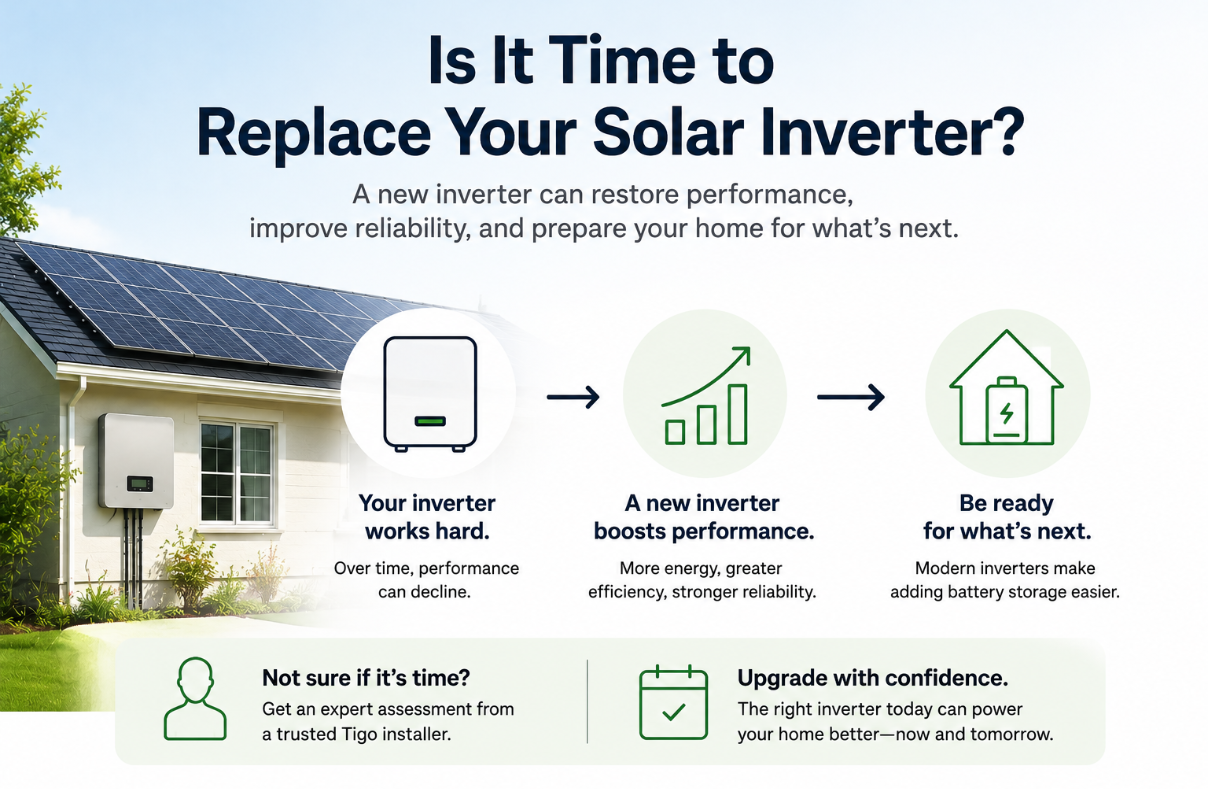
Is It Time to Replace Your Solar Inverter?



Estimated read time: 6–7 minutes
TL;DR
- An inverter error does not automatically mean you need a new solar system — or even a new inverter. Start with diagnosis.
- If the inverter does need replacement, the new unit has to work with the solar array, electrical design, local requirements, monitoring, and your future plans.
- Do not think only in terms of replacing old equipment with a basic equivalent. If storage may matter later, ask whether a storage-ready hybrid inverter makes sense now.
- Use the replacement project to restore what is broken, improve what is useful, and prepare for what you may want next.
- A qualified solar professional should evaluate the complete system before equipment is selected.
Your inverter stopped working. Is replacement the next step?
Maybe — but the first step is confirming that the inverter is actually the problem.
To a homeowner, several solar problems can look the same. Production disappears. The monitoring app goes offline. An error message appears. The electric bill goes up. Those symptoms might point to the inverter, but they can also be caused by communications, wiring, damaged components, shade, or other system conditions.
That is why a qualified solar professional should diagnose the system before anyone orders replacement equipment.
Not sure whether the system is actually underperforming? Read: Is Your Solar System Still Performing Like It Should?
What does the inverter actually do?
Solar panels produce direct-current electricity. The inverter converts that electricity into alternating-current electricity that can be used by your home and the grid. Depending on the system, the inverter may also play a role in monitoring, communications, grid interaction, and other system functions.
Because it does so much work, the inverter often becomes a focal point when an older solar system needs service. Warning lights, repeated shutdowns, error codes, missing production, or obsolete equipment can all be reasons to have it evaluated.
Important:
Do not open an inverter or attempt electrical repairs yourself. Solar equipment can remain energized and should be serviced by qualified professionals.
If the inverter needs replacement, do not treat it like swapping an appliance
A replacement inverter has to fit the solar system that is already on your roof. The installer needs to evaluate the existing modules, wiring, electrical configuration, equipment ratings, monitoring approach, local permitting requirements, and utility requirements.
The system may also be different from the day it was installed. The roof may have changed. Shade may have changed. Equipment may be discontinued. Codes and utility requirements may have changed. That does not mean the project has to become complicated; it means the replacement should be designed intentionally rather than assumed to be a one-for-one swap.
Ask more than “What inverter replaces my old one?”
If you are already replacing a major piece of equipment, this is a useful moment to think about what you want from the system for the next stage of its life.
Start with three questions:
- What must be replaced to restore the system?
- What could be improved while the work is being done?
- What might I want this system to support later?
The first question is about repair. The second might involve better monitoring or module-level visibility. The third is where battery storage often enters the conversation.
Should you consider a hybrid inverter?
If battery storage is something you may want now or in the future, ask the installer whether a storage-ready hybrid inverter makes sense for the project. A hybrid inverter is designed to work as part of a solar-plus-storage architecture rather than handling only the basic solar conversion function.
You do not have to add a battery simply because you choose a storage-ready inverter. The value is optionality. If the system design and compatible products support it, you can make today’s replacement decision with tomorrow’s storage plans in mind.
This is especially useful if you are unsure whether you want storage yet. You may be evaluating backup power, changing utility rates, an electric vehicle, greater use of solar energy after sunset, or simply the desire to add storage later without revisiting every design decision from scratch.
Considering storage now or later? Read: Can You Add Battery Storage to an Existing Solar System?
Where Tigo fits in an inverter replacement
The Tigo EI Inverter (US) is a storage-ready hybrid inverter designed for new and retrofit solar installations. It can be part of the Tigo GO Optimized Energy Storage System and is designed to connect with compatible Tigo storage and monitoring components.
For a homeowner who already needs an inverter replacement, that matters because the conversation can move beyond “How do I get the solar back on?” to “What do I want this system to be able to do next?”
Learn more: Tigo EI Inverter (US) (Should this link to IPOC site or current URL?)
Tigo Energy Intelligence can also provide system visibility, and compatible Tigo TS4 module-level power electronics can support functions such as optimization and module-level monitoring depending on the product and system design. The installer should determine which components are appropriate rather than adding equipment without a clear reason.
What about monitoring when the inverter is replaced?
Do not let monitoring become an afterthought. If your old monitoring is unreliable, unsupported, or no longer useful, ask what you will be able to see after the replacement. At a minimum, you should understand how you will know whether the new system is online and producing.
More detailed monitoring can also give the service professional better information if something changes later. The goal is not more data for the sake of data; it is better visibility into how the system is behaving.
When is a simple replacement enough?
Sometimes the right answer is simply replacing the failed inverter and restoring the system. If the modules, roof, electrical equipment, monitoring plan, and existing design are otherwise in good condition — and you have no need for additional capabilities — a focused replacement may be completely reasonable.
In other cases, the failed inverter is the event that reveals other needs: obsolete monitoring, changing shade, roof work, unsupported equipment, or a desire for storage. That is when inverter replacement becomes part of a broader repowering project.
What about cost and warranties?
Inverter replacement costs can vary widely based on equipment, labor, electrical changes, permitting, roof access, monitoring updates, and whether other work is needed at the same time. Instead of comparing only the price of the inverter, ask for a proposal that separates equipment, labor, required upgrades, optional upgrades, and any ongoing service or platform fees.
Also ask what warranty applies to the new inverter and what happens to warranties on equipment that stays in place. The installer should explain warranty responsibilities clearly so you know who to contact if the new equipment needs service later.
Questions to ask before approving an inverter replacement
- What evidence shows that the inverter needs replacement?
- Is the proposed inverter compatible with my existing solar array?
- What will happen to my monitoring?
- Do permits, inspections, labels, or utility approvals apply to this project?
- Is the proposed inverter storage-ready?
- If I want a battery later, what would have to change?
- What equipment can stay, and what actually needs to be replaced?
- Who will support the system after the work is complete?
Make the replacement solve today’s problem without closing tomorrow’s options
A failed inverter is frustrating, but it can also be a decision point. Restore the system first. Then ask whether this is the right time to improve visibility or prepare for future storage.
The goal is not to buy more equipment than you need. It is to make the replacement decision with a clear understanding of what you may want the home energy system to do next.
Continue learning: Read: Can You Add Battery Storage to an Existing Solar System?
Need an assessment before deciding? Find a Tigo installer
Explore the product: Tigo EI Inverter (US)
