
Blog
September 2, 2026
How to Maintain Your Home Solar System Without Becoming a Solar Technician



Estimated read time: 6–7 minutes
TL;DR
- Solar is generally low maintenance, but homeowners should still know whether the system is online, producing, and free of obvious changes around the roof or equipment.
- In the solar industry, ongoing system care is often called operations and maintenance, or O&M. For homeowners, it mostly means monitoring, basic observation, good records, and professional service when needed.
- You can safely review monitoring, utility bills, and visible conditions from the ground. Electrical work, roof access, and equipment repairs belong with qualified professionals.
- Panel cleaning is site-dependent. Monitoring and a visual check are usually more useful than assuming every system needs a regular cleaning schedule.
- Good O&M is not about turning you into a technician. It is about helping you recognize when the system needs one.
What does solar O&M mean for a homeowner?
“Operations and maintenance” sounds like something that belongs at a power plant. In solar, the term is commonly shortened to O&M, and the idea is much simpler than the name.
For a homeowner, solar O&M is the ongoing care that helps you understand whether the system is operating normally and know when it needs professional attention. It can include monitoring, inspections, cleaning when appropriate, corrective repairs, documentation, roof coordination, and equipment replacement.
You do not need to perform all of those tasks yourself. In fact, many of them should not be DIY projects. The homeowner role is mostly awareness: know what normal looks like, keep basic records, and recognize when something changes.
A simple definition:
Solar O&M is how you keep track of your system over time and make sure the right person steps in when something needs attention.
What can you safely do yourself?
Check your monitoring
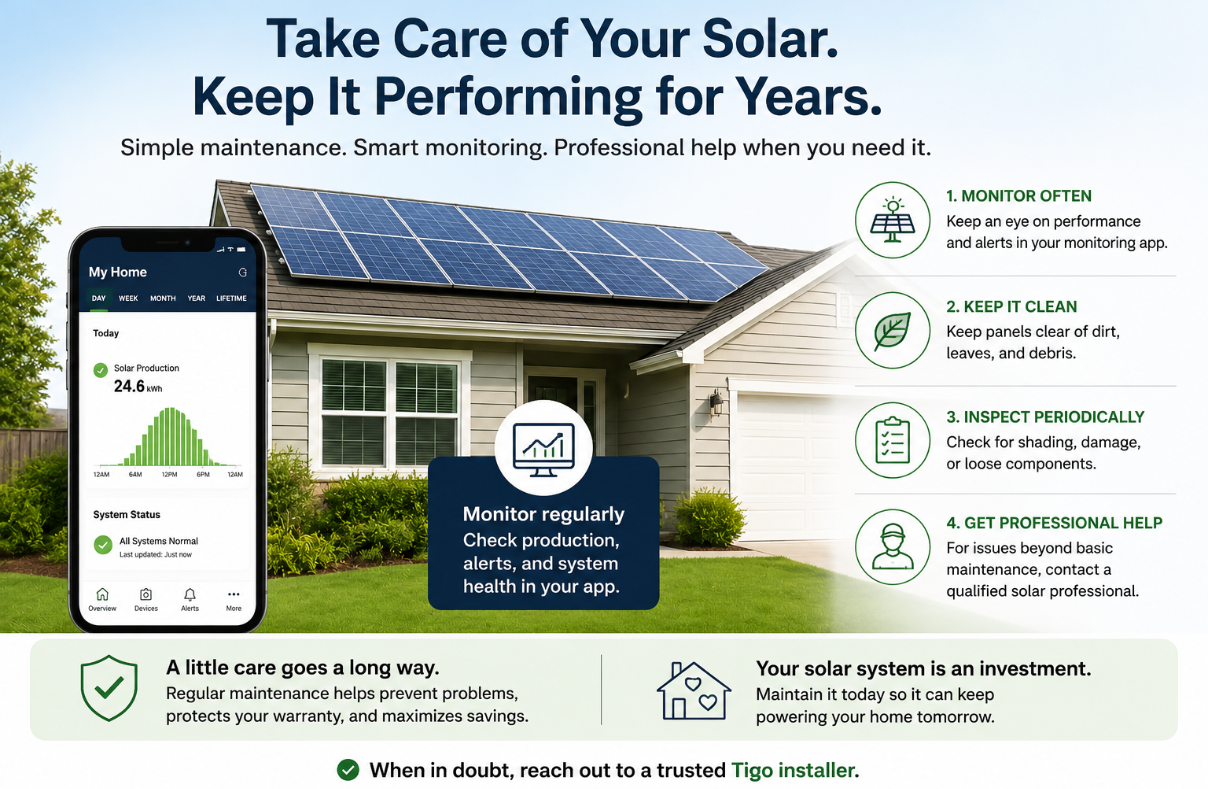
If your system has monitoring, use it. You do not need to stare at daily production charts. A quick check every so often can answer the important questions: Is the system online? Is it producing? Are there alerts? Does production look generally consistent with the same season in prior years?
The U.S. Department of Energy describes monitoring as an important way to confirm PV system performance over time. Good monitoring can help turn a vague feeling that “my bill seems high” into a more useful question about whether solar production actually changed.
Helpful resource: U.S. Department of Energy guidance on operating and maintaining PV systems
Tigo Energy Intelligence is one example of a monitoring platform that can provide system visibility and, when paired with compatible Tigo module-level equipment, more granular information about individual modules.
Learn more: Tigo Energy Intelligence
Look for obvious changes from a safe location
You can notice a lot without climbing onto the roof or opening electrical equipment. Has a tree grown enough to shade the array? Is there visible storm damage or debris? Has anyone recently worked on the roof? Are there obvious warning lights or messages on equipment that can be viewed safely?
If you notice something, take a photo or screenshot and note the date. That information can help the installer understand the history of the problem.
Keep your solar paperwork together
Good documentation is underrated maintenance. Keep the original proposal, system design or permit package if you have it, equipment model numbers, warranty documents, monitoring login information, and service records together. If your original installer disappears years later, those records make it easier for another professional to understand what is installed.
If you are not sure whether the system is still performing normally: Read: Is Your Solar System Still Performing Like It Should?
What should you not DIY?
Solar equipment is electrical equipment, and rooftop work adds fall risk. Homeowners should not open inverter enclosures, disconnect wiring, remove modules, troubleshoot energized circuits, or climb onto the roof simply to investigate a production problem unless they are qualified to do that work.
The right boundary is simple: observation is useful; electrical diagnosis and roof work should be left to qualified professionals.
Do solar panels need to be cleaned?
Sometimes, but not on the same schedule for every home. Rain can remove ordinary dust in many locations. Other sites may collect pollen, wildfire ash, bird droppings, leaves, agricultural dust, or other debris that affects production. Roof pitch and local climate also matter.
Instead of assuming the panels need routine washing, look at the evidence. Is there visible buildup? Did production change? Did production improve after a major rain? If cleaning requires roof access, hire a qualified provider rather than turning maintenance into a safety risk.
The Department of Energy has published homeowner guidance noting that rooftop solar systems have few moving parts and that ordinary precipitation may be enough for many systems. The important point is that cleaning needs are site-specific, not universal.
The roof is part of the solar maintenance plan
Solar does not exist separately from the roof underneath it. If the roof leaks, needs repair, or is approaching replacement, the solar array becomes part of that project. It is better to plan early than to discover during an emergency roof repair that modules must be removed and reinstalled.
Keep notes on roof age and any work completed near the array. If you are planning a roof replacement, involve a qualified solar professional early so the roofing and solar work can be coordinated.
How often should a professional inspect the system?
There is no single inspection schedule that fits every home. The right cadence depends on system age, roof condition, equipment, local weather, warranty terms, and whether monitoring has shown recurring issues. A newer system with reliable monitoring may need little beyond homeowner observation and service when something changes. An older system, a home with repeated faults, or a roof approaching replacement may justify a more proactive professional check.
Rather than paying for visits on an arbitrary calendar, ask what the provider will actually inspect and document. A useful inspection should leave you with clear findings, not simply a statement that the system “looks fine.”
When does routine maintenance become a repair?
Monitoring and observation are meant to catch changes. Once there is a persistent production drop, repeated inverter error, damaged equipment, missing monitoring that cannot be restored remotely, or another clear fault, the job shifts from homeowner maintenance to professional diagnosis.
That does not automatically mean a major replacement. A qualified provider should determine the cause first and separate a focused repair from a broader upgrade.
Do you need a solar O&M plan?
Not every homeowner needs a paid maintenance subscription. Some people are comfortable reviewing their own monitoring and calling for service when something changes. Others prefer a provider who performs periodic inspections, maintains records, or tracks performance.
A service plan may be more useful if the original installer is gone, the system has recurring issues, the home includes battery storage, or you simply prefer ongoing professional oversight. Before signing up, ask what is included, what is excluded, whether parts and labor are covered, how response times work, and whether the provider supports your specific equipment.
A simple homeowner maintenance rhythm
- Check that monitoring is online and review any alerts.
- Compare recent production with similar periods when possible.
- Review utility bills for unexpected changes, while remembering that household use and rates can also change.
- Look from a safe location for new shade, debris, storm damage, or roof changes.
- Keep system documents, warranties, and service records together.
- Call a qualified solar professional when a problem persists, an inverter shows repeated errors, monitoring remains offline, or equipment appears damaged.
That is O&M in homeowner language. You do not need to become a technician. You need enough visibility to know when your system deserves one.
What to do next
If regular checks show that the inverter or another major component may be failing, the conversation shifts from maintenance to repair and repowering. That is the point where the replacement decision can affect what your system is capable of later.
Continue learning: Read: Is It Time to Replace Your Solar Inverter?
Need help with an existing system? Find a Tigo installer
Want to understand the bigger repowering picture? Read: When Your Solar System Stops Working: A Homeowner’s Guide to Repairing, Upgrading, and Repowering
