
Blog
August 4, 2026
How to Package and Sell Solar Repowering Services



TLDR
- Solar repowering is easier to sell when homeowners understand the outcome, not just the equipment being replaced.
- Clear service packages help simplify complex upgrade decisions by connecting each option to production, performance, reliability, and future energy goals.
- A tiered approach allows installers to serve different budgets and system needs while creating natural opportunities for batteries, monitoring, optimization, and future expansion.
- Tigo gives installers the flexibility to build repowering packages around the existing system, rather than forcing every homeowner into a complete replacement.
Sell the Outcome, Not the Equipment
Homeowners rarely begin a repowering conversation by asking for a specific inverter, optimizer, monitoring platform, or battery architecture.
They usually begin with a problem – and most likely will not know of the term repowering at this stage.
All they know is that their system may be underperforming. An inverter may have failed. Monitoring may no longer work. The original installer may be out of business. Or the homeowner may want backup power, EV charging, or greater control over their energy use.
That means the most effective repowering sales conversations should not start with a product list.
They should start with the outcome the homeowner wants:
- Restore lost solar production
- Improve system visibility
- Replace aging or unsupported equipment
- Increase reliability
- Add battery backup
- Prepare for future energy needs
- Extend the useful life of the existing system
Packaging repowering services around these outcomes makes the offer easier to understand and gives homeowners a clearer reason to act.
Why Service Packages Work
Repowering projects can become complicated quickly.
The installer must evaluate the existing system, understand which components still have value, determine compatibility, identify the homeowner’s priorities, and recommend the right level of modernization.
Presenting every possible product and upgrade individually can overwhelm the customer.
Service packages simplify that decision.
Instead of asking homeowners to compare technical components, installers can offer clearly defined paths based on the condition of the system and the homeowner’s goals.
A strong package answers three questions:
- What problem does this solve?
- What is included?
- What future options does it create?
This shifts the conversation away from individual hardware prices and toward the value of the complete solution.
A Three-Tier Repowering Model
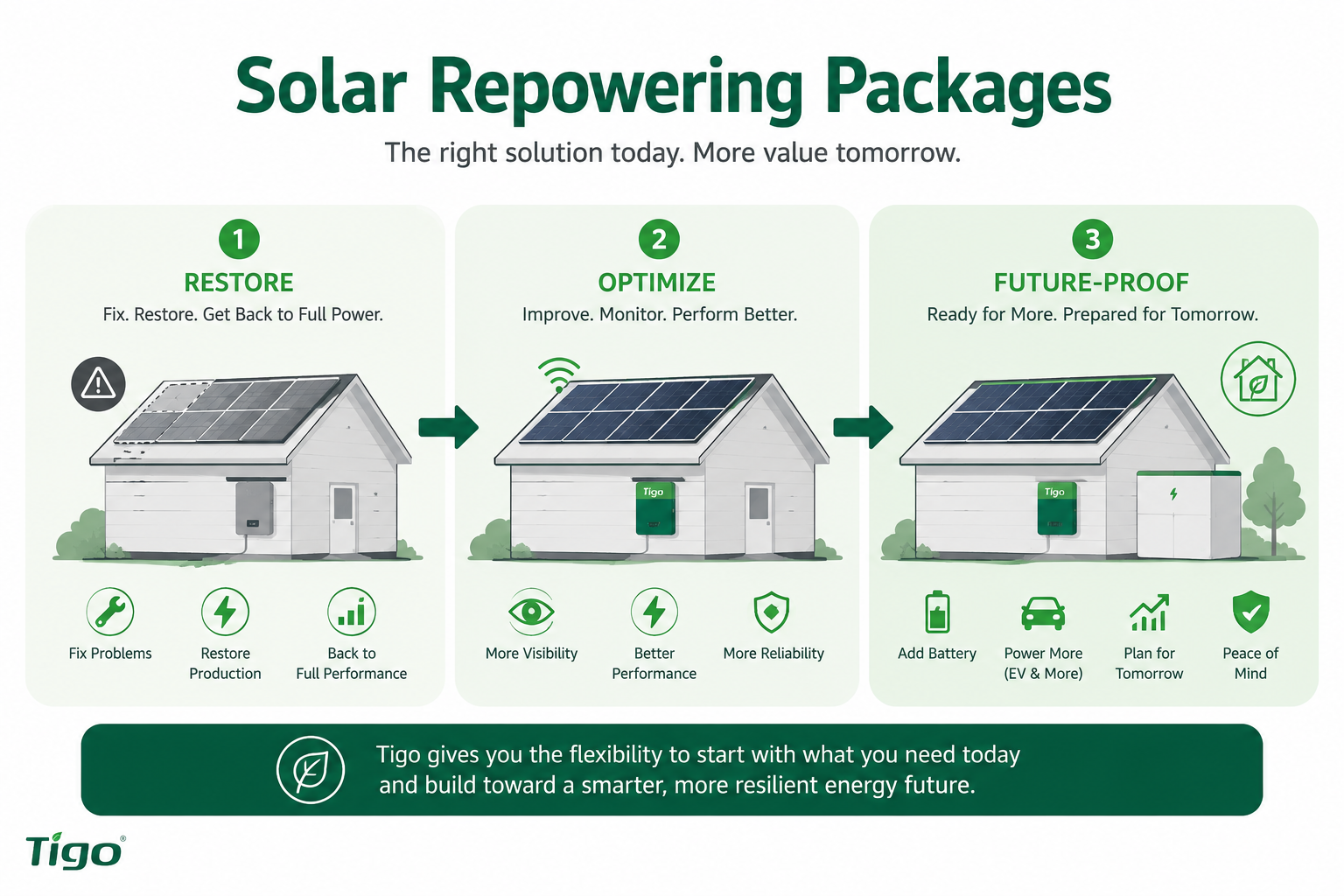
A practical approach is to organize repowering services into three levels.
The names can vary by installer, but the structure should remain simple.
Restore
The Restore package is designed for homeowners whose immediate priority is getting the system operating properly again.
This may include:
- System inspection and diagnosis
- Replacement of failed or aging equipment
- Recommissioning
- Monitoring restoration
- Production verification
- Basic homeowner education
The core value is straightforward: restore operation and recover the value of the existing solar investment.
This package is often the entry point for homeowners who contacted the installer because of a specific failure or production issue.
Optimize
The Optimize package goes beyond repairing the immediate problem. It focuses on increasing system performance, visibility, reliability, or serviceability.
This may include:
- Everything included in Restore
- Inverter modernization
- Module-level monitoring
- Selective optimization
- Improved troubleshooting capabilities
- Safety or electrical upgrades
- Performance verification and follow-up
The homeowner is not simply restoring the system to its previous condition. They are improving how the system performs and how easily it can be monitored and serviced.
The value proposition becomes: fix today’s problem while making the system more capable and easier to manage.
Future-Proof
The Future-Proof package positions the system for future household energy needs.
This may include:
- Everything included in Restore and Optimize
- Battery-ready system design
- Battery storage
- Additional solar capacity
- EV charging considerations
- Load growth planning
- Future monitoring and service agreements
The homeowner may not complete every upgrade immediately. However, the system is designed so that future improvements are easier to add.
The value proposition becomes modernize the system today while creating a clear path for future energy upgrades.
Match the Package to the Homeowner’s Goals
Not every homeowner needs the highest-level package. The goal is not to push the largest scope. It is to identify the right level of modernization for the customer’s current needs, budget, and long-term plans.
A few questions can help guide the conversation:
- Is the homeowner trying to solve a current failure or improve the entire system?
- Does the homeowner plan to add battery storage?
- Are household electricity needs expected to increase?
- Is the homeowner considering an EV, heat pump, or electric water heating?
- How important is module-level monitoring?
- Does the homeowner want backup power?
- How long does the homeowner plan to remain in the home?
- Does the existing equipment still have useful life?
These questions make the sales conversation more consultative and help the installer recommend a package with a clear rationale.
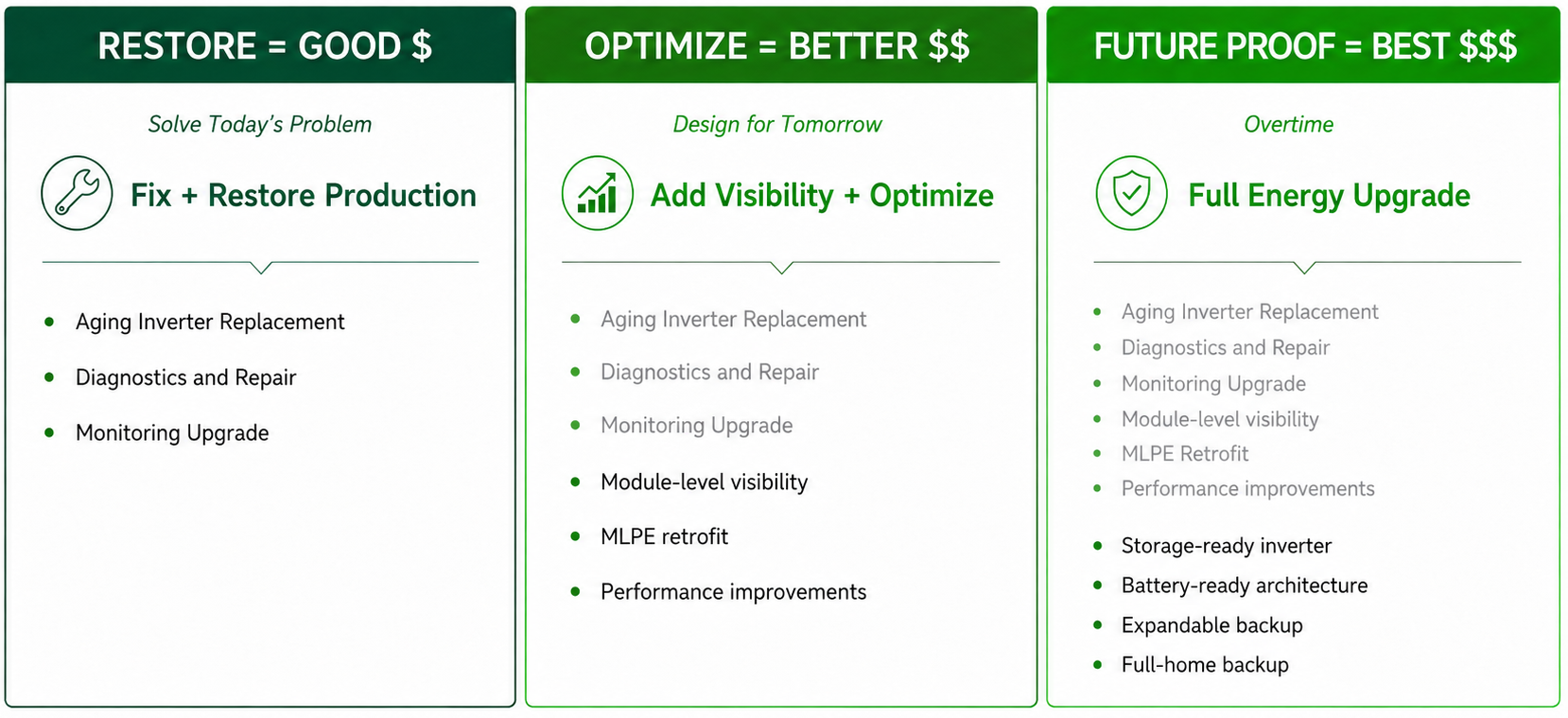
The table should remain focused on customer outcomes rather than becoming a technical specification sheet.
Technical details can still be included in the proposal, but the package comparison should make the buying decision easier.
Price the Complete Service
One common mistake is pricing repowering as if the installer is only replacing equipment.
The customer is also paying for:
- System evaluation
- Troubleshooting
- Design and compatibility review
- Permitting
- Labor
- Recommissioning
- Monitoring setup
- Customer education
- Follow-up support
- Warranty administration
- Future service availability
These activities require time, expertise, and risk management. A profitable proposal should account for the complete scope of work, not just the hardware and installation labor.
This is especially important with older systems, where documentation may be incomplete, equipment may no longer be supported, and site conditions may differ from the original plans.
Packages help make this value visible.
Use the Assessment to Build the Proposal
The site assessment should directly inform the package recommendation.
Rather than producing a generic quote, the proposal should explain:
- What was found
- What requires immediate attention
- Which existing components can remain
- Which equipment should be replaced
- What performance or monitoring improvements are available
- What future upgrades may be worth planning for
- Why the recommended package is the best fit
This gives the homeowner a clear connection between the system’s condition and the proposed solution.
It also helps justify the value of a more comprehensive repowering scope when the existing system has multiple limitations.
Why Tigo Fits a Packaged Repowering Strategy
A package-based approach only works when the installer has enough flexibility to serve different system conditions and customer goals.
Tigo supports that model by giving installers multiple ways to modernize an existing system.
Depending on the project, installers can use Tigo solutions to:
- Restore system operation without replacing the full array
- Add optimization only where it is needed
- Add module-level monitoring for better system visibility
- Improve troubleshooting and long-term serviceability
- Replace aging inverter technology
- Add battery storage
- Plan for future expansion
- Build a more complete solar and storage solution over time
This allows the installer to create a clear progression from Restore to Optimize to Future-Proof. The homeowner can address the immediate need without losing the option to add more capability later.
For installers, that flexibility supports a more consultative sales process and creates a clear path for future service and upgrades.
Keep the Proposal Simple
A strong repowering proposal should not read like an engineering report. It should make the decision clear.

For each option, explain:
- The homeowner’s current problem
- The recommended solution
- The expected outcome
- What is included
- What is not included
- The price
- The future upgrade path
Avoid overwhelming the homeowner with unnecessary product details early in the conversation. Lead with the problem and the value. Use technical details to support the recommendation, not replace it.
Chapter Takeaway
Selling solar repowering successfully requires more than quoting replacement equipment. Installers should package services around the homeowner’s desired outcome: restoring production, improving performance, or preparing the system for future energy needs.
A clear tiered structure simplifies the buying decision, supports better margins, and creates room for future upgrades. With flexible solutions for monitoring, optimization, inverter replacement, battery storage, and system expansion, Tigo helps installers build repowering packages that solve today’s problems while preparing homeowners for what comes next.
Continue Reading
Once the service packages are defined, the next challenge is finding the homeowners and system owners who need them.
Next Chapter 5 → Finding Solar Repowering Customers
--
Below is a full list of chapters included in this series:
- Summary: The Solar Repowering Opportunity
- Why Repowering Has Become a Major Growth Market
- Building a Profitable Solar Repowering Business
- How to Package and Sell Solar Repowering Services
- Finding Solar Repowering Customers
- Launching Your Repowering Business in 90 Days
- Building a Sustainable Solar Repowering Business
- Resources and Glossary of Repowering Terms
