
Blog
July 7, 2026
TPO vs. Cash: Financing Trends and Why Ownership Still Matters



TLDR
- TPO is growing because market conditions changed - not necessarily because it became a better product.
- Changes to federal incentives made ownership more economically challenging while traditional TPO offerings have largely remained unchanged.
- Financing influences how homeowners buy solar, but it doesn't automatically determine long-term value.
- The best installers understand every financing option and help homeowners choose the one that fits their goals.
- Regardless of financing, long-term value still comes from system quality, performance, and serviceability.
The solar industry has seen this before.
Residential solar has always moved in cycles.
Years ago, leases and PPAs dominated the market. Then ownership became the preferred option as financing improved and interest rates remained low. Today, the market is shifting again.
Many installers are seeing more homeowners choose third-party ownership (TPO), including leases and power purchase agreements (PPAs).
At first glance, it might seem like TPO has simply become the better option.
The reality is more nuanced.
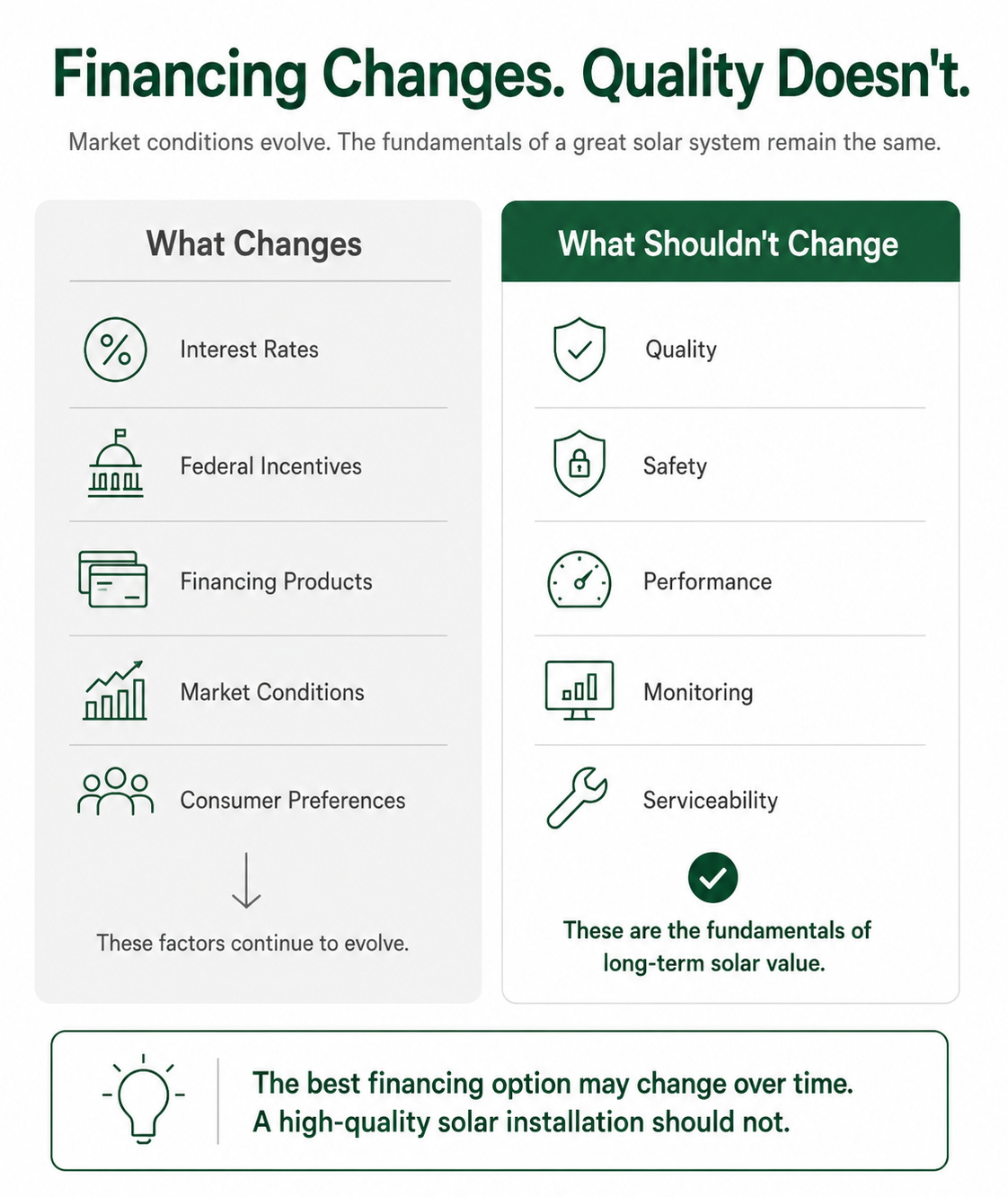
Today's market isn't being driven by one financing product suddenly becoming better. It's being shaped by higher interest rates, changing federal incentives, and homeowners looking for ways to lower monthly costs.
Understanding why the market is changing is just as important as understanding the financing options themselves.
Why TPO Is Growing
TPO is growing for a few simple reasons.
- Homeowners are paying closer attention to monthly costs
- Interest rates remain higher than they were just a few years ago
- Changes to federal incentives have made ownership more challenging for some homeowners
For many families, a lease or PPA lowers the barrier to going solar. Instead of focusing on the total cost of the system, the conversation shifts to monthly savings and little or no upfront investment.
That's a compelling value proposition.
It's also why many installers have shifted their sales approach. When affordability becomes the biggest concern, TPO can be an easier sales conversation than ownership.
But affordability isn't the only reason TPO has gained momentum.
The Role of Federal Incentives
Federal incentives have always influenced the solar market.
For years, the Residential Clean Energy Credit (Section 25D) helped make system ownership more attractive by allowing homeowners to directly benefit from the federal tax credit. As those incentives have changed, ownership has become more economically challenging for many homeowners.
At the same time, many third-party ownership providers may still qualify for commercial tax incentives under Section 48E. That has strengthened the competitive position of TPO, but not necessarily because homeowners are receiving greater value or lower costs. Instead, ownership became more economically challenging, while traditional TPO offerings appear to have remained largely unchanged.
In other words, TPO didn't necessarily become a better product. The market around it changed. Like every financing model, TPO is influenced by changes in federal incentives. As those incentives evolve or dry up, financing products and pricing will likely evolve with them
An Important Distinction
This is where much of today's conversation becomes oversimplified.
Some assume that because many TPO providers can still benefit from Section 48E, homeowners are automatically getting a better deal.
That isn't always the case.
Today, there is little to no public evidence that traditional lease and PPA providers have broadly reduced pricing or significantly increased homeowner savings because of Section 48E.
One emerging exception is prepaid lease products. These newer financing models are designed to pass some of the commercial tax-credit value back to homeowners through discounted pricing and a path to eventual ownership. While promising, they are still relatively new and not yet representative of the broader lease and PPA market.
For installers, the takeaway is simple: evaluate the financing terms, not just the financing model.
Financing Should Match the Homeowner's Goals
The discussion shouldn't start with the financing product.
It should start with the homeowner.
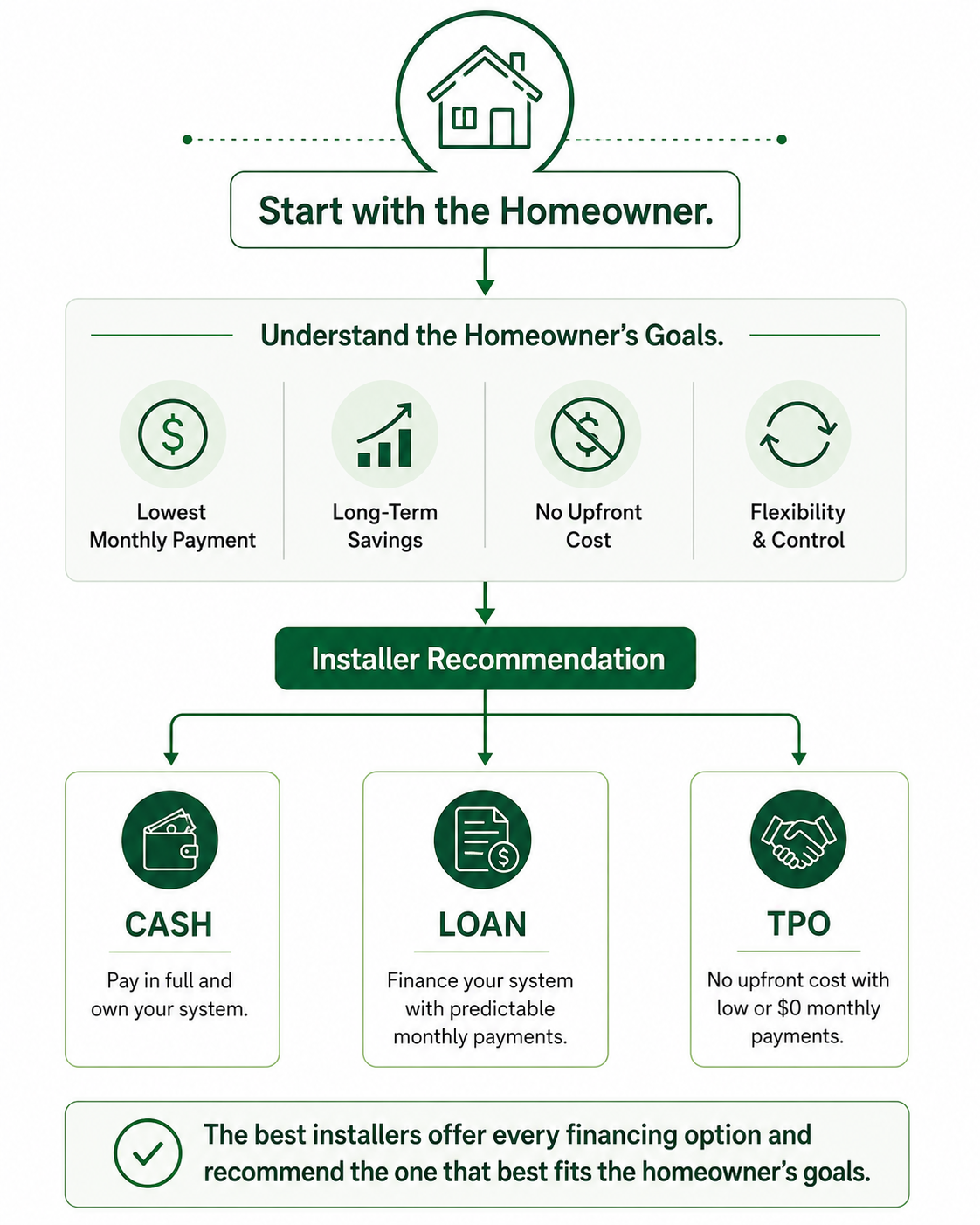
Every homeowner has different priorities. Some want the lowest monthly payment. Others want to maximize long-term savings. Some value flexibility, while others simply want the easiest path to going solar.
That's why there isn't a single "best" financing option.
Cash, loans, and TPO each solve different problems.
The best installers don't lead with a financing product. They ask questions, understand the homeowner's goals, and recommend the financing option that best fits their situation.
Why Ownership Still Matters
While TPO has gained momentum, ownership continues to offer meaningful advantages for many homeowners.
Owning a solar system gives homeowners greater control over their investment. They can choose the equipment that best fits their needs, make upgrades over time, and avoid many of the restrictions that can come with third-party ownership.
Ownership also allows homeowners to capture the long-term value created by the system. While monthly payments may be higher than some TPO offerings, many homeowners value the ability to build equity in the system rather than make payments on an asset they don't own.
For homeowners planning to stay in their homes for many years, ownership often remains an attractive long-term option.
The Installer Perspective
Installers are facing a different challenge.
Today's market is pushing many companies toward TPO because it can simplify the sales process and improve close rates.
Those are real advantages.
But installers should also think about the long-term impact on their business.
Ownership-based projects often create opportunities for:
• Greater flexibility in equipment selection
• Future system upgrades
• Ongoing service opportunities
• Maintaining direct customer relationships and experiences
Offering both ownership and TPO allows installers to meet homeowners where they are while preserving the ability to differentiate their business beyond financing alone.
The goal shouldn't be to sell one financing model.
The goal should be to provide homeowners with the financing option that best supports their needs while delivering a high-quality solar system.
Looking Ahead
The residential solar market will continue to evolve.
Interest rates will change. New financing products will emerge. Federal incentives will continue to influence how homeowners, financing providers, and installers approach solar.
That's nothing new.
The industry has adapted before, and it will adapt again.
For installers, the opportunity isn't relying on a single financing model. It's understanding the strengths and tradeoffs of each one, then helping homeowners make informed decisions based on their goals - not simply the financing product that's easiest to sell.
Homeowners should think the same way. Financing is an important part of the decision, but it isn't the only one. Long-term value also comes from choosing a high-quality system that is safe, reliable, serviceable, and built to perform for decades.
At Tigo, we believe financing should help more homeowners adopt solar - but financing alone doesn't determine long-term success. But no matter how a system is purchased - through cash, a loan, or a third-party ownership model - the quality of the equipment, the ability to monitor and maintain the system, and the flexibility to support homeowners over the life of the installation are what ultimately determine long-term success.
Financing models will continue to evolve. The fundamentals of a quality solar system won't.
