
Duke Energy Power Manager Battery Program
.avif)

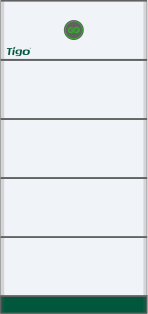

Program summary
Stabilize the Grid in the Carolinas. Earn Valuable Monthly Bill Credits.
Eligible Duke Energy residential electricity customers who have installed the Tigo GO Optimized Energy Storage System (ESS) can earn valuable bill credits for helping manage electricity demand on the electric grid. By participating in the Duke Energy Battery Program (also referred to as the Battery Program), you help the utility manage demand by sending extra, stored power to the grid. This participation helps the community by decreasing the use of less efficient and more expensive energy sources to support the grid.
The Tigo GO Optimized ESS Advantage in Duke Energy Programs
The Tigo GO Optimized ESS, which includes the GO Battery, is built for seamless and efficient participation in these utility-managed programs:
- Valuable Bill Credits: Participants receive ongoing monthly bill credits based on the discharge capacity of their battery system. For instance, a system with a 10 kWh battery capacity is eligible to earn bill credits of $35 per month ($420 per year), and a system with a 15 kWh capacity can earn $53 per month ($636 per year). Systems with 20 kWh of capacity are eligible for $71 per month ($840 per year).
- Optimal Efficiency: The system uses a DC-coupled battery configuration, which is up to 5% more efficient than AC-coupled designs, ensuring more usable energy is available for grid participation.
- Modular Capacity: The GO Battery is modular in 5 kWh increments, allowing systems to scale up to 30 kWh.
- Upfront Incentives (NC): North Carolina Duke Energy customers who install new solar plus battery systems may also be eligible for a one-time upfront incentive from Duke Energy’s PowerPair(SM) Program, totaling up to $9,000.
- Remote Control: Your system must be configured to allow Duke Energy to remotely communicate, control, and adjust parameters to charge and discharge your system.
- Integrated Control: The entire solution is managed under the Tigo Energy Intelligence (EI) platform.
How the Duke Energy Battery Program Works
The Duke Energy Battery Program provides valuable incentives to residential customers when their qualified battery systems are approved by Duke Energy for participation in either Power Manager (for Duke Energy customers) or EnergyWise Home (for Duke Energy Progress customers).
Incentive Structure: Participants receive ongoing monthly bill credits after all eligibility requirements are verified by Duke Energy. Credits are applied to the monthly electric bill no sooner than the next billing cycle after program acceptance. All bill credits are the responsibility of Duke Energy or Duke Energy Progress.
Events: Battery control events are initiated when the utility signals your battery system to discharge energy, typically ranging from one to three hours in duration.
- Participants can expect between 30 to 36 battery control events per year.
- Events occur year-round: up to 18 times between December and March; nine times between May and September; and nine times in April, October, and November.
- Events are typically called 24 to 48 hours in advance.
Stay in Control and Ensure Backup Power:
Once activated, your system is automatically set to participate in all events regardless of the chosen battery operating mode.
- Opt-Out Rule: You may opt out of individual events using the Tigo EI App. However, if you opt out of or miss more than four control events in a single calendar year, Duke Energy reserves the right to remove you from the program.
- Backup Priority: Your battery will be set to full backup mode 12 hours before each event start time until each event ends.
- Discharge Limit: The program imposes a 20% battery discharge limit, which ensures you retain a reserve of backup energy in case of a grid outage during or immediately after an event.
- Storm Safety: Duke Energy will attempt to avoid calling a battery control event if the weather forecast calls for extreme weather that could result in widespread grid power outages.
Steps to enroll
Enrollment is easy and done entirely through the Tigo EI App or EI Portal
- Confirm the Tigo system is installed, commissioned, connected to the internet, and approved for interconnection.
- Open the Tigo EI App or EI Portal
- Click Battery Incentive Programs from the systems dashboard section (under Today and Lifetime Metrics)
- Select the available program, review the details, complete the enrollment form, and submit it for approval.
If needed, use the detailed Battery Incentive Program Enrollment Guide to confirm eligibility and steps with screenshots. Program availability, equipment eligibility, and final approval are determined by the utility or program administrator.